What the Whydah’s Manillas Reveal About the Slave Trade — and the Benin Bronzes
What the Whydah’s Brass Rings Reveal About the Slave Trade — and the Benin Bronzes
The Whydah Pirate Museum contributed to a landmark peer-reviewed study connecting artifacts from the wreck site to one of the most important questions in African art history.
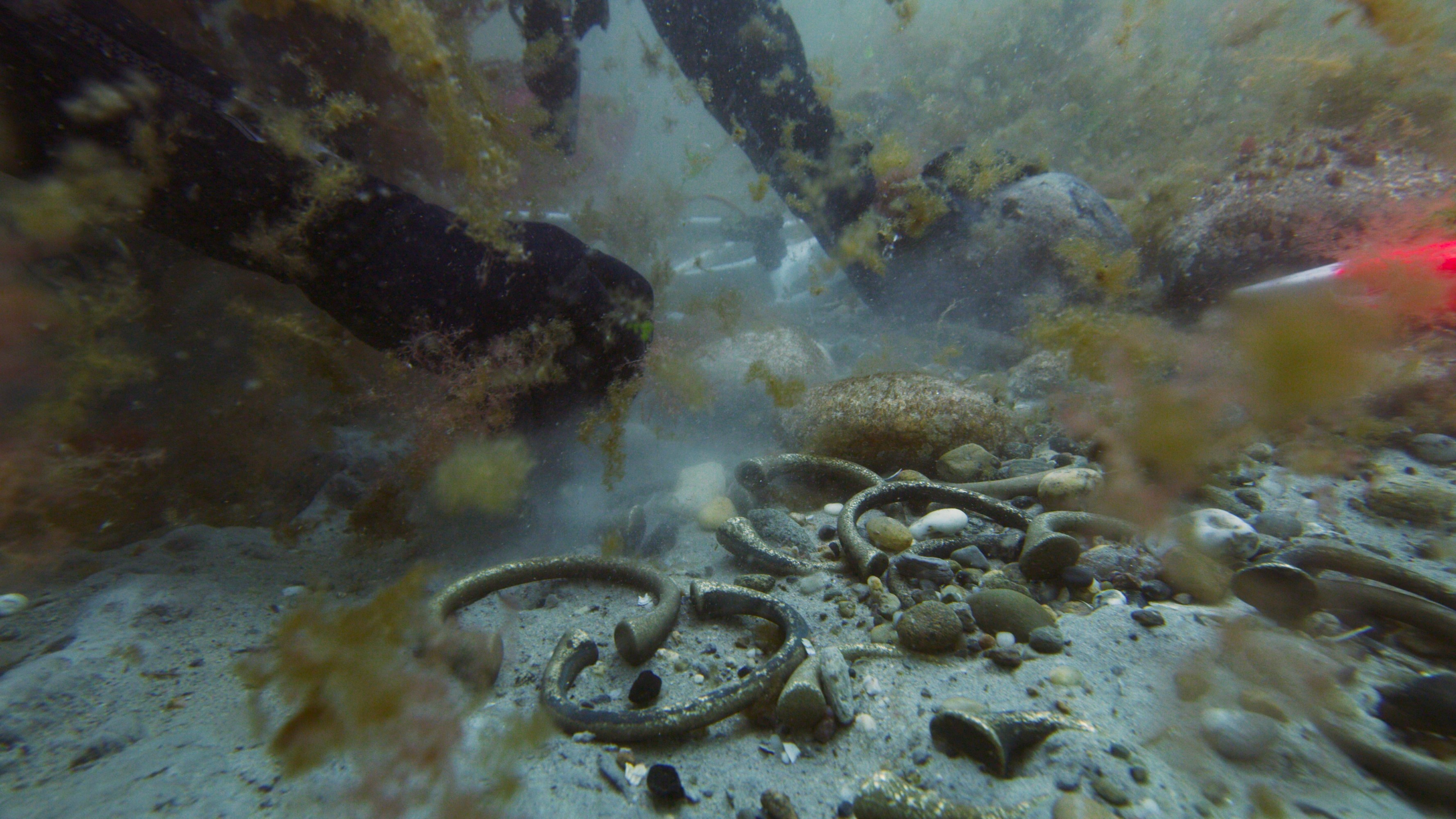
When divers working the Whydah wreck site off Cape Cod pulled up 768 brass rings during the 2018 and 2019 field seasons, they knew the objects were unusual. Small, horseshoe-shaped, and found several hundred feet south of the main wreck debris, the rings — known as manillas — were unlike anything recovered from the site in quantity before. What nobody knew at the time was that those rings would become part of a peer-reviewed scientific study linking the Whydah’s cargo directly to the creation of some of the most celebrated artworks in African history: the Benin Bronzes.
What Are Manillas?
Manillas were brass currency rings produced in Europe and traded along the West African coast from the 15th century onward. They were accepted as currency by African traders and used in exchange for goods — including, as the historical record makes painfully clear, enslaved people. The Whydah, which began her life as a slave ship before Samuel Bellamy’s crew seized her in 1717, was carrying a stock of English trade goods destined for the West African slave trade when she wrecked off Cape Cod. The manillas recovered from her wreck site are believed to be part of that cargo — leftover trade goods from her slaving voyages, still aboard when the storm took her.
The Study
Published in PLOS ONE in April 2023, the peer-reviewed study — titled German Brass for Benin Bronzes: Geochemical Analysis Insights into the Early Atlantic Trade — was led by researcher Tobias Skowronek of the Technische Hochschule Georg Agricola in Bochum, Germany, with contributions from a team of international scholars. Brandon Clifford and Andrew Barker of the Whydah Pirate Museum are listed as contributors, providing the Cape Cod manillas for analysis.
The researchers analyzed 67 manillas from five shipwreck sites and three land sites spanning the 16th to 19th centuries — including 20 manillas from the Whydah site off Cape Cod. Using geochemical analysis, they traced the lead isotope ratios and trace element compositions of each manilla back to their original metal sources.
The Finding
The results were striking. The study definitively identified the German Rhineland — the region between Cologne and Aachen — as the principal source of the brass used in the early Portuguese manillas traded to West Africa from the 15th through 18th centuries. More significantly, the lead isotope ratios of those early manillas showed a remarkable similarity to those of the Benin Bronzes — thousands of extraordinary brass sculptures and plaques produced by the Edo people of Nigeria between the 16th and 19th centuries.
For decades, historians had suspected that manillas melted down by Edo craftsmen provided the raw material for the Benin Bronzes, but no study had been able to conclusively prove the chemical connection. This study, drawing on manillas recovered from shipwrecks including the Whydah, finally made that link.
In short: the same type of brass rings that were traded for enslaved people along the West African coast were very likely the raw material that Edo metalsmiths transformed into some of the most celebrated artworks in African history.
What the Whydah’s Manillas Tell Us
The Cape Cod manillas are classified as “popo” type — a transitional style between the earlier Portuguese manillas and later English production. Their lead isotope ratios point to Cornish and Welsh copper sources, consistent with English manufacture in the early 18th century. This aligns with the Whydah’s history as a London-built vessel outfitted for the triangular trade — Europe to Africa, Africa to the Americas, and back again.
The study notes that over 200,000 artifacts have now been recovered from the Whydah site, and that more manillas are expected to be found as excavations continue.
Why This Matters
The Whydah has always been more than a pirate story. She is a physical record of the Atlantic world of 1717 — the slave trade, global commerce, colonial power, and the human lives caught inside all of it. The manillas in her hold were currency in one of the most brutal economic systems in human history. The fact that those same rings — recovered from the ocean floor off Cape Cod — have now contributed to solving a centuries-old mystery about African art and culture is a reminder of just how much history a single shipwreck can hold.
Research Citation
Skowronek TB, DeCorse CR, Denk R, Birr SD, Kingsley S, Cook GD, Benito Dominguez AM, Brandon A. Clifford, Barker A, Suárez Otero J, Caramés Moreira V, Bode M, Jansen M, Scholes D. (2023) German brass for Benin Bronzes: Geochemical analysis insights into the early Atlantic trade. PLOS ONE 18(4): e0283415.
Published: April 5, 2023
DOI: https://doi.org/10.1371/journal.pone.0283415
The Whydah Pirate Museum is home to the world’s only authenticated pirate treasure, recovered from the wreck of Captain Samuel Bellamy’s flagship off Cape Cod. Visit us at 674 MA-28, West Yarmouth — open year-round.